Monitors Buying Guide (2026): What Matters and 8 Picks
As Amazon Associates, we earn from qualifying purchases. This means we may receive a small commission at no extra cost to you if you click through and make a purchase.
As an Amazon Associate we earn from qualifying purchases. Links on this page are affiliate links.
This monitor buying guide helps you choose the right display for your desk. You will decide between resolution, refresh rate, and panel type based on your actual needs. We compare eight models ranked by their published specifications. Each pick is selected strictly from technical data to ensure accuracy. You can trust these choices to match your workflow without guesswork.
The list covers productivity screens like the Dell 32-Inch 4K and gaming displays such as the Sceptre 34-Inch Curved 240Hz. You will see how USB-C connectivity simplifies laptop setups or how curved ultrawide panels enhance immersion. We explain what each spec means in practice. This approach ensures you find a monitor that fits your space and performance requirements. Read on to see the detailed breakdown of each recommended model.
Key Monitor Specs to Check

Resolution and Screen Size
Resolution defines pixel count and clarity. Higher resolution on the same screen size yields sharper text and images. A 4K display on 32 inches offers dense detail for productivity and media. A 1440p panel on 27 inches balances sharpness and performance. Ultrawide formats add horizontal space for multitasking or immersive gaming. Match resolution to your viewing distance and task needs. Too high a resolution on a small screen may require scaling. Too low on a large screen reveals pixelation. Choose based on your primary activity, whether that is detailed editing or fast-paced gaming.
Look for
- 4K for sharp media and work
- 1440p for balanced performance
- Ultrawide for multitasking
Refresh Rate
Refresh rate measures how many times per second the screen updates. Higher rates like 240Hz provide smoother motion in fast games. Standard 60Hz or 75Hz panels are sufficient for office work and browsing. A 120Hz or 144Hz panel offers a middle ground. Gamers benefit from high refresh rates for reduced blur. Non-gamers may not notice the difference. Consider your source hardware. A high refresh rate monitor is wasted if your computer cannot output that speed. Match the rate to your use case and GPU capabilities.
Look for
- 240Hz for competitive gaming
- 120Hz+ for smooth visuals
- 75Hz for office tasks
Panel Type
Panel type affects color accuracy, contrast, and viewing angles. VA panels offer high contrast, making blacks look deeper. They are common in curved monitors and budget 4K displays. IPS panels provide better color accuracy and wider viewing angles. TN panels are rare now but offer speed. Mini-LED technology enhances contrast and brightness significantly. Your choice depends on whether you prioritize deep blacks for movies or accurate colors for creative work. Curved screens often use VA panels for immersion. Flat screens may use IPS for professional accuracy.
Look for
- VA for high contrast
- IPS for color accuracy
- Mini-LED for HDR brightness
Variable Refresh Rate
Variable Refresh Rate (VRR) syncs the monitor's refresh rate with your graphics card's frame output. This prevents screen tearing and stuttering. FreeSync is a common VRR standard. It works with AMD and some NVIDIA cards. VRR is essential for gaming to maintain smoothness during frame drops. It is less critical for static content like web browsing or word processing. Check compatibility with your specific GPU. If you game, ensure your system supports the monitor's VRR standard for the best experience.
Look for
- FreeSync for tear-free gaming
- Check GPU compatibility
- Essential for smooth motion
Ports and Connectivity
Ports determine what devices you can connect. HDMI and DisplayPort are standard for video input. USB-C allows video, data, and power delivery over one cable. This is ideal for laptop docking. More ports offer flexibility for multiple devices. Some monitors include USB hubs for peripherals. Check if your devices match the available ports. A lack of USB-C may require extra adapters. Ensure you have enough video inputs for your setup. Consider future-proofing with newer standards if available.
Look for
- USB-C for laptop docking
- HDMI and DisplayPort for video
- USB hubs for peripherals
Aspect Ratio and Curvature
Aspect ratio defines the screen shape. Standard 16:9 is common for most content. Ultrawide 21:9 ratios offer extra horizontal space. This is great for gaming immersion and multitasking. Curved screens wrap around your field of view, reducing edge distortion. They often enhance immersion in games and movies. Flat screens are better for tasks requiring straight lines, like design work. Choose based on desk space and preference. Ultrawide monitors require more width. Curved screens may have fixed stands.
Look for
- 21:9 for multitasking
- Curved for immersion
- 16:9 for standard content
Ergonomics and Stand
The stand affects comfort and desk space. Height-adjustable stands allow you to raise or lower the screen. This reduces neck strain. Swivel and tilt options help you find the perfect angle. Some monitors have fixed stands, limiting adjustment. A sturdy base prevents wobbling. Consider VESA mount compatibility if you plan to use an arm. This frees up desk space. Ergonomics matter for long work sessions. Check the stand's range of motion before buying.
Look for
- Height-adjustable for comfort
- VESA mount for flexibility
- Sturdy base for stability
Monitor Types by Use Case

4K Productivity Displays
These monitors prioritize sharp text and detailed imagery for office work and media consumption. The Dell S3225QS offers 4K resolution on a 32-inch VA panel with 120Hz refresh. This setup suits users who need high pixel density for spreadsheets and photos. The trade-off is slower response times compared to gaming panels. You get strong color accuracy but limited motion clarity. It fits desks where viewing distance is closer and speed is less critical than clarity.
Ultrawide Gaming Monitors
Ultrawide screens provide a 21:9 aspect ratio for immersive gaming and multitasking. Models like the Sceptre C345B-QU240T and SANSUI ES-G34C5 PRO offer 240Hz refresh rates. These curved displays wrap around your field of view for better immersion. They are ideal for fast-paced games where peripheral vision matters. The main trade-off is the higher price per inch and potential compatibility issues with older graphics cards. You gain screen real estate but lose the square aspect ratio of standard monitors.
USB-C Docking Monitors
These displays focus on connectivity and desk cleanliness for laptop users. The Dell S2722DC uses USB-C for single-cable video and power delivery. It features a 27-inch 1440p panel with ergonomic adjustability. This type suits professionals who connect one laptop to their entire setup. The trade-off is a lower 75Hz refresh rate, which feels less smooth for gaming. You sacrifice high-speed performance for convenience and cable reduction. It is the best choice for static office environments.
High-Refresh QHD Panels
Standard 1440p monitors with high refresh rates balance clarity and speed. The Sceptre E325B-QW200D and AOC Q27G3XMN fit this category. They offer 1440p resolution with 210Hz or 180Hz refresh rates. These panels suit gamers who want sharp images without the cost of 4K or ultrawide. The AOC model adds Mini-LED for better contrast. You get a versatile middle ground between productivity clarity and gaming smoothness. The trade-off is that they lack the extreme immersion of ultrawide screens.
Common Monitor Buying Mistakes

Ignoring panel type for color work
VA panels offer high contrast but suffer from slow response times and color shifting when viewed from angles. If you edit photos or video, choose IPS or OLED panels. These technologies provide accurate colors and wide viewing angles, ensuring your work looks correct on any device.
Matching refresh rate to low-end GPU
A 144Hz or 240Hz monitor is useless if your graphics card cannot drive those frame rates in games. Check your GPU specifications before buying. A high refresh rate only benefits you if your system can consistently output high frames. Otherwise, a standard 60Hz or 75Hz panel is sufficient.
Overlooking connectivity compatibility
Ensure your computer has the correct ports to match the monitor. Many modern monitors require DisplayPort for high refresh rates or USB-C for video and power delivery. HDMI versions vary in bandwidth. Check your source device outputs to avoid signal limitations or missing features like audio return.
Neglecting ergonomic adjustability for long hours
Fixed stands can cause neck strain during long work sessions. Look for monitors with height, tilt, and swivel adjustments. Some models offer pivot rotation for vertical content. Proper ergonomics reduce physical fatigue. Verify that the stand allows you to position the screen at eye level and comfortable distance.
Assuming all 4K monitors are equal
Resolution alone does not guarantee a good experience. Pixel density matters based on screen size. A 27-inch 4K screen offers sharper text than a 32-inch version. Also, check scaling settings in your operating system. Small UI elements may become unreadable without proper software scaling adjustments on high-density displays.
| # | Product | Best for | Price |
|---|---|---|---|
| 1 | Dell 32-Inch 4K 120Hz Monitor | 4K productivity and media consumption | |
| 2 | Sceptre 34-Inch Curved 240Hz Ultrawide Monitor | fast-paced ultrawide gaming | |
| 3 | Sceptre 32-Inch QHD 210Hz USB-C Monitor | large screen gaming with USB-C convenience | |
| 4 | SANSUI 34-Inch Curved 200Hz Ultrawide Monitor | immersive ultrawide gaming setups | |
| 5 | Dell 27-Inch 1440p USB-C Monitor | Single-cable laptop docking and ergonomic desk setups | |
| 6 | Sceptre 34-Inch Curved 165Hz Ultrawide Monitor | Ultrawide multitasking and immersive gaming | |
| 7 | SANSUI 34-Inch 240Hz Curved Ultrawide Monitor | competitive gaming on ultrawide displays | |
| 8 | AOC 27-Inch Mini-LED 1440p Gaming Monitor | High-contrast QHD gaming with HDR support |

Dell 32-Inch 4K 120Hz Monitor
Best for: 4K productivity and media consumption
- Screen Size
- 31.5in
- Resolution
- 3840×2160
- Refresh Rate
- 120Hz
- Response Time
- 4ms
- Variable Refresh Rate
- AMD FreeSync Premium
- Ports
- HDMI, DisplayPort
The Dell S3225QS is a 32-inch monitor with a 4K UHD VA panel and 120Hz refresh rate. It covers 99% sRGB and 95% DCI-P3 for accurate color. AMD FreeSync Premium ensures smooth visuals. Improved ComfortView Plus reduces blue light. The ash white design features ultra-thin bezels. It suits users who want high resolution and color fidelity for work and media.
- 4K UHD 3840×2160 resolution on a 32-inch VA panel
- 120Hz refresh rate with AMD FreeSync Premium
- 99% sRGB and 95% DCI-P3 color coverage
- ComfortView Plus reduces blue light to ≤35%
- 120Hz refresh rate is lower than the 200Hz to 240Hz options on this list
- 1500:1 contrast ratio is lower than the 3000:1 ratio found in other VA models here
- 19.3-pound weight is heavier than the 27-inch alternatives
- You need 4K resolution for detailed work or media
- You prioritize color accuracy with wide gamut coverage
- You want a minimalist ash white design with thin bezels
- You require refresh rates above 120Hz for competitive gaming
- You prefer a lighter monitor for easier desk placement
- You need a higher contrast ratio for deep black levels
Verdict: Dell S3225QS 32-inch 4K VA Monitor delivers sharp 4K visuals and strong color accuracy for creative tasks. It fits users who value resolution and comfort over high-speed gaming performance.

Sceptre 34-Inch Curved 240Hz Ultrawide Monitor
Best for: fast-paced ultrawide gaming
- Screen Size
- 34 inches
- Resolution
- 3440 x 1440
- Refresh Rate
- 240Hz
- Response Time
- 1ms
- Ports
- DisplayPort x2, HDMI x2
- Features
- Built-in Speakers, Curved Screen
This Sceptre monitor features a 34-inch ultrawide QHD display with a 240Hz refresh rate. It includes built-in speakers and 100% sRGB color coverage. The curved screen offers a 1500R radius and 1ms response time. It suits gamers who want high speed and immersive visuals. The design keeps your desk clutter-free with integrated audio.
- 240Hz refresh rate for smooth visuals
- 100% sRGB color gamut
- Built-in speakers
- 1ms response time
- Heavier at 14 pounds compared to some lighter alternatives
- Larger 34-inch size requires more desk space than 27-inch models
- You want a high refresh rate for competitive gaming
- You prefer an immersive curved screen experience
- You need built-in audio for convenience
- You need a 4K resolution display
- You prefer a flat screen over a curved one
- You have limited desk space for a 34-inch monitor
Verdict: Sceptre 34-inch Curved Gaming Monitor delivers high-speed performance with its 240Hz refresh rate. It fits gamers who prioritize smooth motion and immersive ultrawide visuals.

Sceptre 32-Inch QHD 210Hz USB-C Monitor
Best for: large screen gaming with USB-C convenience
- Screen Size
- 32-inch
- Resolution
- 2560 x 1440
- Refresh Rate
- Up to 210Hz
- Response Time
- 1ms BR
- Variable Refresh Rate
- AMD FreeSync Premium
- Ports
- HDMI, DisplayPort, USB Type-C
The Sceptre 32-inch monitor delivers a 2560 x 1440 resolution on a VA panel with a 210Hz refresh rate. It includes USB Type-C connectivity for video and power, plus built-in speakers. The 115% sRGB coverage supports vivid colors. This setup suits gamers who want high speed and a large screen without external audio gear.
- 210Hz refresh rate for smooth motion
- USB Type-C port for connectivity
- Built-in speakers reduce desk clutter
- 115% sRGB color gamut coverage
- 10.1 pounds weight is heavier than many 27-inch competitors
- 1440p resolution is lower than the 4K or UWQHD options on this list
- 210Hz speed is lower than the 240Hz panels available elsewhere
- You need a large 32-inch display for immersive gaming
- You want USB Type-C convenience for your laptop
- You prefer built-in speakers to keep your desk tidy
- You require 4K UHD resolution for sharp text
- You need the highest 240Hz refresh rate available
- You prefer a lighter monitor for easy desk movement
Verdict: Sceptre 32-inch 2K Gaming Monitor offers a fast 210Hz panel and USB-C connectivity in a large 32-inch frame. It fits players who prioritize screen size and modern ports over the highest resolution or speed found in other picks.

SANSUI 34-Inch Curved 200Hz Ultrawide Monitor
Best for: immersive ultrawide gaming setups
- Screen Size
- 34-Inch
- Resolution
- 3440 x 1440
- Refresh Rate
- 200Hz
- Panel Type
- Fast VA
- Response Time
- OD 1ms
- Aspect Ratio
- 21:9
This 34-inch ultrawide monitor delivers a 3440 x 1440 resolution on a curved VA panel. It supports a 200Hz refresh rate and 1ms response time for smooth gaming. The stand offers tilt adjustment and VESA mounting compatibility. You get two HDMI 2.1 ports and one DisplayPort for connectivity. It includes AI features for blue light reduction and crosshairs. This setup suits those who want a large, high-speed display for immersive play.
- 200Hz refresh rate for fast motion
- 3440 x 1440 UWQHD resolution
- 1500R curved screen for immersion
- VESA compatible mounting options
- AI crosshair and blue light tools
- Heavier build at 15.4 pounds
- Limited tilt range of -5° to 15°
- No built-in speakers
- You need a wide 21:9 aspect ratio
- You want high refresh rates for gaming
- You have space for a 34-inch display
- You require built-in audio
- You prefer a flat screen design
- You need height adjustable stands
Verdict: SANSUI 34-inch 200Hz Curved Monitor fits gamers who prioritize speed and screen real estate. It provides a solid ultrawide experience for immersive titles. The heavy base and fixed stand limit desk flexibility.

Dell 27-Inch 1440p USB-C Monitor
Best for: Single-cable laptop docking and ergonomic desk setups
- Screen Size
- 27-inch
- Resolution
- 2560×1440
- Refresh Rate
- 75Hz
- Response Time
- 4Ms
- Variable Refresh Rate
- AMD FreeSync
- Ports
- USB-C, USB 3.2 Gen 1 Type-A
The Dell S2722DC is a 27-inch WQHD monitor with a 75Hz refresh rate and AMD FreeSync support. It features USB-C connectivity with 65W power delivery, allowing you to charge laptops while transmitting video and data through a single cable. The stand offers height, tilt, swivel, and pivot adjustments for ergonomic positioning. Built-in speakers provide basic audio without external hardware. This model suits users prioritizing clean desk setups and productivity over high-speed gaming performance.
- USB-C port with 65W power delivery for single-cable laptop connection
- Height-adjustable stand with tilt, swivel, and pivot capabilities
- WQHD (2560×1440) resolution for sharp image clarity
- Built-in speakers reduce desktop clutter
- 75Hz refresh rate is lower than the 120Hz to 240Hz rates found on other list items
- 27-inch screen size is smaller than the 32-inch and 34-inch ultrawide options on the list
- 11.9-pound weight is lighter but offers less substantial build compared to larger panels
- You need USB-C connectivity to charge a laptop and connect peripherals with one cable
- You require ergonomic adjustments like height, tilt, and pivot for comfortable viewing angles
- You prefer a compact 27-inch display for standard desktop workflows
- You require high refresh rates above 100Hz for competitive gaming
- You want a larger 32-inch or ultrawide 34-inch screen for immersive viewing
- You need HDMI-only connectivity without USB-C support
Verdict: Dell S2722DC 27-inch WQHD Monitor is ideal for professionals who value clean, single-cable laptop setups and ergonomic adjustability over high refresh rates or large screen real estate.

Sceptre 34-Inch Curved 165Hz Ultrawide Monitor
Best for: Ultrawide multitasking and immersive gaming
- Screen Size
- 34-inch
- Resolution
- 3440 x 1440
- Refresh Rate
- up to 180Hz/165Hz
- Response Time
- 1ms
- Aspect Ratio
- 21:9
- Ports
- DisplayPort x2
This 34-inch ultrawide monitor delivers WQHD resolution (3440 x 1440) across a 21:9 aspect ratio. It features a 1500R curve and supports refresh rates up to 180Hz. The panel covers 99% of the sRGB color space. A 1ms MPRT response time helps reduce motion blur. The design includes built-in speakers and LED backcover lights. It suits users needing extra horizontal screen real estate for productivity or gaming.
- 3440 x 1440 WQHD resolution
- 180Hz refresh rate capability
- 99% sRGB color coverage
- 1500R curved screen design
- Built-in speakers included
- 180Hz refresh rate is lower than the 240Hz options on this list
- 15.3-pound weight is heavier than many standard 27-inch monitors
- Limited to DisplayPort connectivity in the listed ports
- You need a wide 21:9 screen for multitasking
- You want a curved display for immersive gaming
- You prefer a monitor with built-in audio
- You require a 240Hz or higher refresh rate
- You need multiple connection types like HDMI
- You prefer a compact 27-inch form factor
Verdict: Sceptre 34-inch Curved WQHD Monitor offers a solid ultrawide experience with high color accuracy and smooth motion. It fits users who prioritize screen width and a curved field of view over maximum refresh rates.

SANSUI 34-Inch 240Hz Curved Ultrawide Monitor
Best for: competitive gaming on ultrawide displays
- Screen Size
- 34 Inch
- Resolution
- 3440×1440
- Refresh Rate
- 240Hz
- Panel Type
- Fast VA
- Response Time
- 1ms
- Aspect Ratio
- 21:9
This SANSUI monitor offers a 34-inch curved VA panel with 240Hz refresh rate. It delivers UWQHD resolution at 3440×1440 pixels. The display includes HDR400 support and AI-enhanced gaming features. You get a metal stand with tilt adjustment and VESA compatibility. It connects via HDMI 2.1 and DisplayPort 1.4. This setup suits gamers seeking high speed and a wide field of view.
- 240Hz refresh rate for smooth motion
- UWQHD 3440×1440 resolution
- 1500R curved screen design
- Metal stand with tilt adjustment
- HDMI 2.1 and DP 1.4 ports
- HDR400 rating is lower than the HDR1000 found on the AOC model
- VA panel type may have slower pixel response than IPS alternatives
- 34-inch width requires more desk space than 27-inch options
- You play fast-paced games and want high refresh rates
- You prefer an ultrawide 21:9 aspect ratio for immersion
- You need VESA mounting compatibility for your setup
- You require HDR1000 brightness for professional color work
- You have a small desk and need a 27-inch footprint
- You want built-in speakers for audio output
Verdict: SANSUI 34-inch 240Hz UWQHD Monitor fits competitive gamers who value high refresh rates and ultrawide immersion. It delivers strong performance for its price point, though the HDR400 rating limits its appeal for content creators needing higher peak brightness.
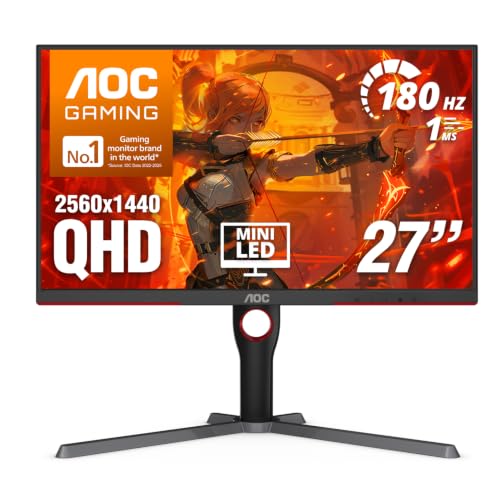
AOC 27-Inch Mini-LED 1440p Gaming Monitor
Best for: High-contrast QHD gaming with HDR support
- Screen Size
- 27 Inch
- Resolution
- 2560×1440
- Refresh Rate
- 180Hz
- Response Time
- 1ms GtG
- Variable Refresh Rate
- Adaptive-Sync
- Ports
- USB 3.2, DP 1.4, HDMI 2.1
This 27-inch QHD monitor uses Mini-LED technology with 336 dimming zones for high contrast. It offers a 180Hz refresh rate and 1ms response time for smooth gaming. The panel covers 134% of the sRGB color gamut and supports VESA DisplayHDR 1000. You get a height-adjustable stand and a frameless design. It suits gamers who want vivid images and fast performance in a compact 27-inch footprint.
- Mini-LED backlight with 336 dimming zones for deep blacks
- 180Hz refresh rate with 1ms GtG response time
- 134% sRGB color gamut coverage
- Height-adjustable stand included
- VESA DisplayHDR 1000 certification
- 15.6-pound weight is heavier than many 27-inch competitors
- 180Hz refresh rate is lower than the 200Hz to 240Hz options in this list
- 27-inch size is smaller than the 34-inch ultrawide choices on the list
- You want high contrast and HDR performance on a standard 16:9 screen
- You prefer a height-adjustable stand for ergonomic setup
- You need a compact 27-inch monitor for your desk
- You require a 34-inch ultrawide display for immersive gaming
- You need a refresh rate of 240Hz or higher for competitive play
- You prefer a lighter monitor that is easier to mount
Verdict: AOC 27-inch Mini-LED Gaming Monitor delivers strong contrast and color accuracy for its size. It fits you well if you value HDR performance and ergonomic adjustability over maximum resolution or ultrawide fields of view.
Specifications side by side

| Spec | Dell 32-Inch 4K 120Hz Monitor | Sceptre 34-Inch Curved 240Hz Ultrawide Monitor | Sceptre 32-Inch QHD 210Hz USB-C Monitor | SANSUI 34-Inch Curved 200Hz Ultrawide Monitor | Dell 27-Inch 1440p USB-C Monitor | Sceptre 34-Inch Curved 165Hz Ultrawide Monitor | SANSUI 34-Inch 240Hz Curved Ultrawide Monitor | AOC 27-Inch Mini-LED 1440p Gaming Monitor |
|---|---|---|---|---|---|---|---|---|
| Screen Size | 31.5in | 34 inches | 32-inch | 34-Inch | 27-inch | 34-inch | 34 Inch | 27 Inch |
| Resolution | 3840×2160 | 3440 x 1440 | 2560 x 1440 | 3440 x 1440 | 2560×1440 | 3440 x 1440 | 3440×1440 | 2560×1440 |
| Refresh Rate | 120Hz | 240Hz | Up to 210Hz | 200Hz | 75Hz | up to 180Hz/165Hz | 240Hz | 180Hz |
| Panel Type | – | – | – | Fast VA | – | – | Fast VA | – |
| Response Time | 4ms | 1ms | 1ms BR | OD 1ms | 4Ms | 1ms | 1ms | 1ms GtG |
| Aspect Ratio | – | – | – | 21:9 | – | 21:9 | 21:9 | – |
| Variable Refresh Rate | AMD FreeSync Premium | – | AMD FreeSync Premium | AdaptiveSync, VRR | AMD FreeSync | – | Freesync | Adaptive-Sync |
| Ports | HDMI, DisplayPort | DisplayPort x2, HDMI x2 | HDMI, DisplayPort, USB Type-C | 2x HDMI 2.1, 1x DP 1.4 | USB-C, USB 3.2 Gen 1 Type-A | DisplayPort x2 | 2x HDMI 2.1, 2x DP 1.4 | USB 3.2, DP 1.4, HDMI 2.1 |
| Features | – | Built-in Speakers, Curved Screen | Built-in Speakers | HDR, Curved Screen | Built-in Speakers | Built-in Speakers, Curved Screen | HDR, Curved Screen | HDR, Height-Adjustable Stand, Audio Support |
| Use | – | Gaming | Gaming | Gaming | – | – | Gaming | Gaming |
| Size | S3225QS | 34 Inch | 32 Inch | 34 Inch | 27 Inch | – | 34 Inch | 27" 180Hz Mini-LED |
| Dimensions | 8.73 × 28.1 × 17.6 inches | 8.5 × 31.8 × 18 inches | 8.32 × 28.2 × 19.5 inches | 8.6 × 31.8 × 18 inches | 6.88 × 24.1 × 15.8 inches | 8.6 × 31.8 × 18 inches | 7.48 × 31.8 × 17.9 inches | 10.2 × 23.8 × 20.9 inches |
| Weight | 19.3 pounds | 14 pounds | 10.1 pounds | 15.4 pounds | 11.9 pounds | 15.3 pounds | – | 15.6 pounds |
| Color | Ash White | Machine Black | Machine Black | Black | Platinum Silver | Black | Black | Black |
| Model | S3225QS | C345B-QU240T | E325B-QW200D | ES-G34C5 | S2722DC | C345B-QUT168 | ES-G34C5 PRO | Q27G3XMN |
Frequently asked questions
Is a 34-inch ultrawide monitor better than a 27-inch standard display?
It depends on your workflow. Ultrawide models like the Sceptre C345B-QUT168 provide a 21:9 aspect ratio for immersive gaming and multitasking. Standard 27-inch panels, such as the AOC Q27G3XMN, offer higher pixel density for sharper text. Choose ultrawide for screen real estate and standard sizes for detailed clarity.
Do I need a high refresh rate for productivity work?
Most office tasks run smoothly at 60Hz or 75Hz. The Dell S2722DC operates at 75Hz, which is sufficient for spreadsheets and web browsing. Higher rates like 120Hz or 240Hz benefit gaming and fast-motion content. You can save on performance specs if you do not play competitive games.
Which monitor supports a single-cable laptop connection?
Look for models with USB-C ports that deliver video and power. The Dell S2722DC and Sceptre E325B-QW200D both feature USB-C connectivity. This allows you to connect your laptop with one cable for data, video, and charging. It simplifies desk setups by reducing cable clutter significantly.
What is the difference between VA and Mini-LED panels?
VA panels, like those in the Dell S3225QS, offer high contrast ratios for deep blacks. Mini-LED technology, found in the AOC Q27G3XMN, uses local dimming zones for brighter HDR highlights. Mini-LED generally provides better peak brightness and color volume compared to standard VA backlighting.
Can I mount any of these monitors on a VESA arm?
Most modern monitors support VESA mounting standards for flexible positioning. The Sceptre and SANSUI ultrawide models typically include standard hole patterns. Check the specifications for your specific model to confirm compatibility. Mounting arms allow you to adjust height and angle for better ergonomics.
Is HDR important for gaming monitors?
HDR enhances contrast and color depth in supported games. The SANSUI ES-G34C5 PRO and AOC Q27G3XMN feature HDR capabilities. Higher HDR ratings indicate better peak brightness for visual impact. Basic HDR support is common, but higher standards offer more vivid highlights in dark scenes.
See also