Solar System and Space LEGO Building Sets: Decisive Buyer’s Guide
As Amazon Associates, we earn from qualifying purchases. This means we may receive a small commission at no extra cost to you if you click through and make a purchase.
Choosing the right model to explore the lego planets solar system requires balancing mechanical orbital accuracy, vertical or horizontal display footprints, and overall assembly depth. Space enthusiasts and busy parents often face a crowded field of sets with vastly different engineering goals, from functional celestial orreries that track seasonal rotations to multi-stage rocketry models developed alongside real-world space agencies. Pinpointing the right build means determining whether you want a kinetic desk showpiece driven by intermeshed gear trains, an educational classroom model, or an imaginative spaceship designed for modular reconstruction.
This comprehensive guide examines five distinct space-themed construction sets to simplify your buying decision. Across this collection, the models diverge significantly in scale, mechanical sophistication, and educational intent. Our analysis evaluates a full mechanical nine-planet planetary array, a precision-engineered Earth and Moon orrery, an authentic NASA heavy-lift launch rocket, a versatile three-in-one exploratory craft, and a futuristic single-seat starship. By evaluating piece counts, footprint dimensions, and kinetic features side by side, this comparison helps you identify which build best matches your available display space and interest. If you want to explore broader cosmic themes across our guides, check out our selection of space lego sets for related recommendations.
Which LEGO Building Sets Should You Buy
- Complete Celestial Layout: Solar System Building Blocks offers a broad nine-planet mechanical display driven by linked manual gears.
- Precision Astronomical Orrery: LEGO Technic Planet Earth and Moon delivers scientifically calibrated rotations showing lunar phases and seasonal orbital paths.
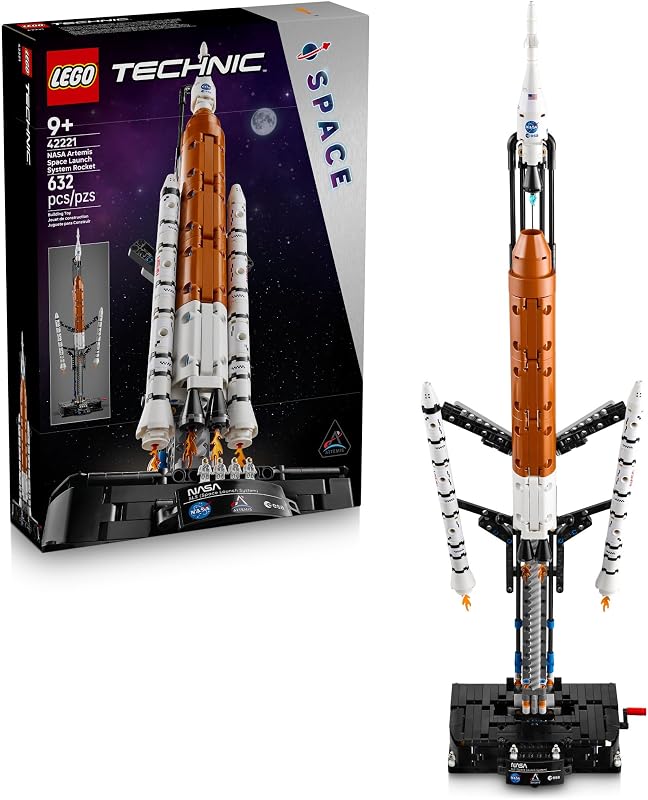
- Aerospace Engineering and Staging: LEGO Technic NASA Artemis Space Launch features an authentic vertical launch vehicle with a functional three-stage separation crank.
- Versatile Desktop Rebuilding: LEGO Creator 3 in 1 Space provides three separate space builds in one compact, travel-friendly package.
- Fast Sci-Fi Flight Play: LEGO City Interstellar Spaceship Toy focuses on rapid assembly, fold-out thruster mechanics, and imaginative single-pilot play.
Solar System Building Blocks

DaTeng Pin
4.4 average from Amazon buyers
- Size
- 30x30x25.5CM
- Dimensions
- 12 x 10 x 12 inches
Listed by the seller on the product page.
Best for: Desks needing a complete nine-planet layout
Pros
- Full nine-planet orbital mechanical display
- Rotatable handle drives multi-gear linkages
- Generous 946-piece STEM engineering build
Cons
- Non-LEGO brand small particle construction
- Wide 30-centimeter footprint demands space
The Solar System Building Blocks set presents a broad, mechanical representation of our astronomical neighborhood. Built from 946 plastic small particle parts, this planetary model integrates nine celestial bodies, including the Earth, Sun, Moon, and surrounding planetary spheres, accented by miniature orbital satellites and space rockets. The primary visual draw is its wide structural base, measuring 30 centimeters in length, 30 centimeters in width, and 25.5 centimeters in height, establishing a prominent, square footprint suited for wide display tables or science classroom desks.
From an educational and mechanical perspective, this kit serves as an engaging hands-on STEM project for builders aged 8 and up. Turning the integrated side handle activates a multi-gear linkage train beneath the orbital arms, causing the central Earth to orbit the Sun while the Moon concurrently rotates around Earth. This interconnected movement provides a tangible demonstration of multi-gear engineering principles and spatial astronomy. The set arrives in a fine gift box packaging with detailed step-by-step instruction steps designed to support collaborative parent-child building sessions.
Where this set steps aside for other options is in its licensing ecosystem and specialized gear tolerances. Manufactured by DaTengPin under model number KQ101, it does not use official LEGO Technic parts or provide calibrated calendar dials. Those who require exact lunar month markings or official space agency branding will find better synergy with specialized orrery models. However, for builders who prioritize a comprehensive visual display of all nine planetary bodies over single-planet calibration, this 946-piece set delivers a substantial mechanical build.
- Nine-planet celestial layout featuring model rockets, orbital satellites, and Earth-Moon orbital linkages
- Manual hand crank mechanism driving multi-gear linkages that demonstrate planetary motion principles
- Substantial display structure measuring 30 centimeters long, 30 centimeters wide, and 25.5 centimeters high
- Includes 946 plastic particle components, detailed manual steps, and gift box packaging
LEGO Technic Planet Earth and Moon

LEGO
4.6 average from Amazon buyers
- Color
- Multicolor
- Dimensions
- 15.039 x 10.315 x 3.701 inches
- Weight
- 2.23 Pounds
Listed by the seller on the product page.
Best for: Students learning seasonal cycles and orbital mechanics
Pros
- Working crank-driven Earth and Moon orrery
- Printed calendar months and moon phase dials
- Official 526-piece Technic gear design
Cons
- Excludes outer solar system planets
- Manual crank operation only
The LEGO Technic Planet Earth and Moon in Orbit set (model 42179) narrows its focus to provide a scientifically calibrated demonstration of terrestrial and lunar motion. Comprising 526 Technic elements, this model is specifically engineered for builders aged 10 and up who appreciate functional mechanical accuracy. Instead of crowding the mechanism with external planetary spheres, it concentrates entirely on the celestial mechanics linking the Sun, Earth, and Moon through a system of intermeshed Technic gears and structural liftarms.
A standout educational feature of this build is its printed reference rings. The lower planetary base includes crisp, printed indicators for the twelve calendar months alongside cyclical moon phases. When you turn the manual crankshaft, the Earth rotates on its axial tilt while simultaneously orbiting the radiant Sun, as the Moon faithfully tracks around the Earth. This precise gearing helps young learners and adult space enthusiasts visually connect mechanical revolutions to Earth’s seasons, daylight shifts, and gravitational lunar alignments. If you want to see how other celestial alignments are tackled in brick form, explore our breakdown of lego solar eclipse sets. The completed build measures over 9 inches (24 cm) high, 12.5 inches (33 cm) long, and 7 inches (18 cm) wide, creating a clean display profile that fits neatly onto office bookshelves.
In a direct lego building sets comparison, this kit trades away the broader nine-planet scope of generic sets to achieve superior mechanical tolerance and authentic educational value. Builders construct the internal gear ratios using standard Technic pins, axles, and gears, which can be monitored in 3D through the digital LEGO Builder app. For working professionals who want an authentic, kinetic astronomical centerpiece that accurately reflects our yearly orbit, this 526-piece Technic kit stands out as a top-tier choice.
- Precision crankshaft mechanism demonstrating simultaneous Earth rotation, lunar orbit, and solar transit
- Printed base dials detailing calendar months and moon phases to illustrate seasonal changes
- 526-piece Technic engineering kit designed for builders aged 10 and up
- Functional display footprint measuring over 9 inches high, 12.5 inches long, and 7 inches wide
LEGO Technic NASA Artemis Space Launch
LEGO
4.2 average from Amazon buyers
- Color
- Multicolor
- Dimensions
- 10.315 x 15.039 x 2.776 Inches
- Weight
- 2.23 Pounds
Listed by the seller on the product page.
Best for: Aerospace fans wanting a tall rocket showcase
Pros
- Working 3-stage mechanical separation crank
- Official NASA and ESA collaboration replica
- Towering 27.5-inch vertical display height
Cons
- Requires substantial vertical shelf clearance
- Focuses on rocketry without planetary bodies
Shifting from celestial mechanics to modern aerospace exploration, the LEGO Technic NASA Artemis Space Launch System Rocket (model 42221) recreates human deep-space transport architecture. Developed in official collaboration with NASA and the European Space Agency (ESA), this 632-piece kit replicates the massive rocket built to send the Orion spacecraft into lunar orbit. Measuring over 27.5 inches (70 cm) high, 6.5 inches (16 cm) long, and 3 inches (8 cm) wide, the completed model makes a dramatic vertical statement in an executive office or home study.
The core interactive highlight of this set is its authentic three-stage rocket separation mechanism. Rather than relying on simple friction pins, the model uses an integrated hand crank to mechanically separate the booster and propulsion stages. As you turn the crank, the solid rocket boosters release from the main orange core stage, the core stage detaches, and the upper stage deploys with its engine module, launch abort system, and the encapsulated Orion spacecraft. The inclusion of translucent blue engine exhaust flames, four astronaut nanofigures, and an official informational display plaque cements its status as a collector-grade aerospace showcase.
When deciding which lego building set to buy, this Artemis SLS model caters directly to rocketry enthusiasts rather than those seeking planetary orreries. It does not chart orbits or simulate seasonal cycles. Instead, it demonstrates the mechanical staging principles required to achieve escape velocity. For hobbyists seeking a tall, officially branded NASA conversation piece that highlights modern lunar missions, this 632-piece Technic kit provides remarkable engineering presence.
- Official NASA and ESA collaboration replicating the Artemis Space Launch System rocket and Orion capsule
- Hand-cranked 3-stage mechanical separation system simulating authentic booster and stage deployment
- Striking vertical profile measuring over 27.5 inches tall with an informative display panel
- Includes 632 pieces, 4 astronaut nanofigures, and translucent blue propulsion exhaust details
LEGO Creator 3 in 1 Space

LEGO
4.7 average from Amazon buyers
- Color
- White
- Size
- pack of 1
- Dimensions
- 7.52 x 5.551 x 1.811 inches
- Weight
- 0.2 pounds
Listed by the seller on the product page.
Best for: Casual builders wanting multiple quick desk models
Pros
- Three distinct space builds in one box
- Opening shuttle bay with detachable satellite
- Compact 144-piece rapid assembly
Cons
- Cannot build all three models simultaneously
- Lacks mechanical gear linkages
The LEGO Creator 3 in 1 Space Shuttle (model 31134) offers an accessible, modular building experience that prioritizes creative reconstruction over complex mechanical linkages. Containing 144 elements, this compact set is tailored for builders aged 6 and up, providing three separate build configurations using the exact same assortment of bricks. The primary build assembles a classic orbiter space shuttle featuring an opening cargo bay hatch that houses an extendable, detachable satellite payload on an articulated arm.
Once builders finish flying orbital shuttle missions, the bricks can be broken down and rebuilt into two distinct alternative models. The second option constructs a posable astronaut figure featuring jointed arms and legs, a propulsion jetpack, and a display stand complete with a plantable flag. The third build option configures a streamlined sci-fi spaceship featuring posable, movable wings designed for imaginative atmospheric flight. The LEGO Builder app provides interactive 3D tools that let younger builders rotate and inspect each subassembly digitally during the build process.
Measuring over 2.5 inches (6 cm) high, 5 inches (12 cm) long, and 6 inches (16 cm) wide in its shuttle form, this set occupies minimal physical space. It lacks the complex kinetic gear assemblies of the Technic sets and makes no attempt to simulate astronomical orbits. However, for buyers seeking a quick, relaxing build or a portable desk toy that can be reconfigured whenever boredom strikes, this 144-piece Creator set delivers outstanding versatility.
- Three-in-one building flexibility assembling a classic Space Shuttle, posable astronaut, or spaceship
- Space shuttle configuration features an opening payload bay with an extendable, removable satellite
- Articulated astronaut figure includes jointed limbs, a wearable jetpack, and a plantable flag on a stand
- Compact 144-piece construction measuring 2.5 inches high, 5 inches long, and 6 inches wide
LEGO City Interstellar Spaceship Toy

LEGO
4.4 average from Amazon buyers
- Color
- Multicolor
- Dimensions
- 10.315 x 7.52 x 1.811 inches
- Weight
- 0.78 pounds
Listed by the seller on the product page.
Best for: Young sci-fi enthusiasts wanting handheld flight play
Pros
- Engaging fold-out thruster wing mechanism
- Includes astronaut minifigure and drone jetpack
- Accessible and fast assembly process
Cons
- The listing does not specify piece count
- Fictional design without real-world science
Designed for fast-paced sci-fi storytelling and active handheld play, the LEGO City Interstellar Spaceship Toy (model 60430) introduces a futuristic exploratory vessel for builders aged 6 and up. While the listing does not specify the exact total piece count, the kit provides an aerodynamic, single-seat cockpit fighter aesthetic. The set is engineered around an intuitive play feature: builders insert a toy battery pack cylinder into the ship’s engine core to automatically deploy the fold-out main propulsion thrusters for simulated high-speed space travel.
In addition to the main spacecraft, the box includes a full-sized space crew astronaut minifigure and an accompanying drone bot companion. In a clever design twist, the drone bot detaches from its structural mount and converts into a wearable propulsion jetpack that clips directly onto the astronaut minifigure’s back. Digital instructions via the LEGO Builder app allow younger builders to inspect the hull’s angular construction from all angles, ensuring an easy and satisfying assembly experience.
Within this lineup of space sets, the Interstellar Spaceship sits furthest from real-world scientific education and planetary tracking. It does not represent historical NASA hardware or simulate celestial orbits. Instead, it provides durable, swoop-friendly imaginative play that integrates seamlessly with the broader LEGO City space line. For buyers seeking an action-focused space toy with kinetic fold-out thruster wings, it serves as an exciting, low-friction addition to any shelf.
- Futuristic single-seat spacecraft featuring interactive fold-out main propulsion thruster wings
- Tactile engine activation mechanism engaged by inserting an included toy battery pack element
- Includes a space astronaut minifigure and a modular drone bot that transforms into a wearable jetpack
- Part of the modular LEGO City space range with full support for digital 3D app instructions
What Sets These Models Apart
Evaluating these space-themed construction sets reveals clear distinctions in piece density, functional complexity, and intended display orientation. The planetary models emphasize wide, horizontal table clearance to accommodate sweeping orbital arms, whereas the rocketry and exploratory vessels focus on vertical clearance or compact aerodynamic handling. The table below outlines the key mechanical differences and primary functional targets across all five featured builds.
| Product Name | Piece Count | Primary Focus | Key Mechanism |
|---|---|---|---|
| Solar System Building Blocks | 946 | Complete 9-planet layout | Multi-gear crank driving Earth-Moon orbits |
| LEGO Technic Planet Earth and Moon | 526 | Astronomical calendar & lunar phases | Calibrated crankshaft orrery with printed dials |
| LEGO Technic NASA Artemis Space Launch | 632 | Official NASA rocketry replica | Hand-cranked 3-stage rocket separation |
| LEGO Creator 3 in 1 Space | 144 | Modular 3-in-1 rebuilding | Opening bay hatch and articulating joints |
| LEGO City Interstellar Spaceship Toy | The listing does not specify | Futuristic flight role-play | Toy battery pack engaged fold-out thrusters |
Buying Tips for LEGO Building Sets
When selecting among the best lego space building sets, your first consideration should be available display space and shelf clearance. Vertical builds like the Technic NASA Artemis Space Launch require more than 27.5 inches of vertical clearance, making them ideal for tall display cases or unencumbered desk corners, but unsuitable for tight enclosed bookshelves. Conversely, mechanical orreries like the Technic Planet Earth and Moon or the Solar System Building Blocks demand substantial horizontal surface area to allow the sweeping planetary arms to complete full 360-degree rotations without colliding with nearby walls or monitors.
Your second decision point centers on the underlying engineering philosophy. If your primary objective is exploring gear ratios, astronomical cycles, and mechanical linkages, Technic and gear-driven models provide an unmatched tactile lesson in physics. Printed details like month tracks and moon phases turn an assembly project into a functional educational instrument. On the other hand, if you value dynamic storytelling, modular brick versatility, or rebuilding options, standard system brick models like the Creator 3 in 1 line offer superior long-term replay value at a fraction of the build complexity.
Finally, align the builder’s age and assembly patience with the construction system. Technic sets demand methodical attention to axle orientations, gear backlash, and pin friction, which can frustrate younger children if attempted without supervision. Casual builders looking for an evening distraction will appreciate the straightforward snap-fit construction of the City and Creator sets, while those seeking a sustained engineering challenge will find greater satisfaction in the 500-to-900-piece mechanical assemblies.
FAQ
How does an astronomical orrery model differ from standard space building sets?
An astronomical orrery model is a specialized mechanical clockwork device that uses linked gear trains to demonstrate the relative physical positions and orbital motions of celestial bodies. Unlike static spaceships or rocket models, an orrery uses precise gear ratios so that turning a single handle moves the Earth around the Sun while concurrently rotating the Moon around the Earth, accurately visualizing astronomical time and orbital cycles.
Which model is best suited for demonstrating seasonal changes and moon phases?
The LEGO Technic Planet Earth and Moon is engineered specifically for this purpose. Its base ring incorporates printed calendar months alongside moon phase illustrations, allowing builders to track how the Earth’s axial tilt and continuous orbit around the Sun dictate earthly seasons, while simultaneously tracking how the Moon’s relative position creates distinct lunar phases throughout the year.
Can the LEGO Creator 3 in 1 Space Shuttle build all three models at the same time?
No, the LEGO Creator 3 in 1 set uses a shared pool of 144 building elements to assemble one model at a time. To build the posable astronaut figure or the futuristic spaceship, you must first disassemble the space shuttle model, making it a modular rebuilding experience rather than a three-model display kit.
What shelf clearance is required for the NASA Artemis Space Launch System?
The LEGO Technic NASA Artemis Space Launch System stands over 27.5 inches (70 cm) high when the rocket is mounted onto its display base. It requires at least 28 inches of vertical shelf clearance and a stable, level surface measuring at least 6.5 inches long by 3 inches wide to accommodate its vertical launch footprint securely.
Are digital building instructions available for these space sets?
Yes, all official LEGO models featured in this guide support the digital LEGO Builder app. The app provides interactive 3D digital instructions that allow builders to rotate assemblies, zoom in on intricate gear mechanisms, track construction milestones, and visualize finished subassemblies directly from a smartphone or tablet.