Intel NVMe SSD Guide: Decisive Storage Picks for Busy Professionals
As Amazon Associates, we earn from qualifying purchases. This means we may receive a small commission at no extra cost to you if you click through and make a purchase.
Selecting an ssd nvme intel storage solution requires balancing bus throughput, NAND architecture, and thermal requirements against your actual daily computing demands. Busy professionals upgrading mobile workstations, office desktops, or compact home lab servers often encounter confusing performance metrics that do not reflect real-world multitasking responsiveness. Whether you are transferring large project folders, compiling software repositories, managing virtual machine images, or replacing an aging SATA drive, understanding how solid-state drives utilize the NVMe protocol across various PCI Express lanes is essential for securing a dependable system upgrade.
This guide evaluates three distinct high-performance storage solutions to help you conduct a direct intel nvme ssd comparison without unnecessary complexity. We analyze two classic PCIe 3.0 drives built on Intel QLC NAND alongside an ultra-fast PCIe 5.0 drive engineered for maximum throughput on modern motherboards. By examining differences in raw sequential transfer rates, storage capacities ranging from 512GB to 4TB, and thermal behaviors under load, you will be equipped to choose the optimal storage upgrade for your workstation or portable setup.
Which Intel NVMe SSDs Should You Buy
- Intel 660p Series M.2 2280 2TB: Best for secondary workstation storage, massive data repositories, and high-capacity local file archives.
- Intel 670p Series M.2 2280 512GB: Best for dedicated operating system installations, quick system startups, and everyday office multitasking.
- Crucial T705 PCIe Gen5 NVMe 4TB: Best for elite creative workstations, heavy video editing pipelines, and maximum bandwidth on next-generation platforms.
Intel 660p Series M.2 2280 2TB

Intel
4.0 average from Amazon buyers
- Size
- 2 TB
- Dimensions
- 6.5 x 4.75 x 0.75 inches
- Weight
- 0.02 pounds
Listed by the seller on the product page.
Best for: Large secondary storage and archival data libraries
Pros
- 2TB digital storage capacity
- PCIe 3.0 x4 interface
- Standard M.2 2280 form factor
Cons
- Modest 1800 MB/s transfer speeds
- QLC write drop during sustained transfers
The Intel 660p Series M.2 2280 2TB is engineered to deliver spacious solid-state storage utilizing Intel QLC 3D NAND technology. Built around the PCIe NVMe 3.0 x4 interface, this M.2 2280 module delivers sequential read speeds of up to 1800 MB/s and matching sequential write speeds of 1800 MB/s. By leveraging quad-level cell architecture, the drive packs two terabytes of usable space onto a single compact circuit board measuring 22 by 80 millimeters, making it an accessible option for systems that require significant storage volume without the latency of legacy mechanical disks.
For professionals managing expansive multimedia catalogs, software repositories, or document archives, this drive offers an excellent balance between capacity and reliability. When retrofitting a general-purpose desktop or pairing it with a high-efficiency mobile setup like an hp laptop 16 ram configuration, the drive provides far higher throughput than legacy SATA interfaces. The listing notes broad compatibility with servers, storage arrays, personal computers, notebooks, and business machines that support M.2 PCIe devices, providing flexible deployment options across varied hardware environments.
While the 660p handles everyday file transfers and office applications smoothly, users managing continuous multi-gigabyte data ingest may encounter architectural limitations. Because quad-level cells rely on dynamic cache allocation, sustained heavy write operations can saturate the cache buffer and reduce write performance during intense file transfers. Professionals who prioritize rapid operating system responsiveness and faster sequential reads will find a more specialized alternative in the 670p, while extreme bandwidth tasks are better addressed by modern Gen5 solid-state hardware.
- PCIe NVMe 3.0 x4 interface with sequential read and write speeds up to 1800 MB/s
- Spacious 2TB digital storage capacity built on Intel QLC 3D NAND
- Compact M.2 2280 form factor measuring 22 by 80 mm for versatile system fit
- Broad compatibility across desktops, laptops, servers, and storage arrays
Intel 670p Series M.2 2280 512GB
Intel
4.6 average from Amazon buyers
- Color
- 512GB
- Size
- 512GB
- Dimensions
- 0 x 0 x 0 inches
- Weight
- 0.2 pounds
Listed by the seller on the product page.
Best for: Fast operating system boots and everyday multitasking
Pros
- Up to 3000 MB/s read speed
- Standard M.2 2280 compatibility
- Efficient everyday application loading
Cons
- 512GB digital storage capacity ceiling
- 1600 MB/s sequential write limit
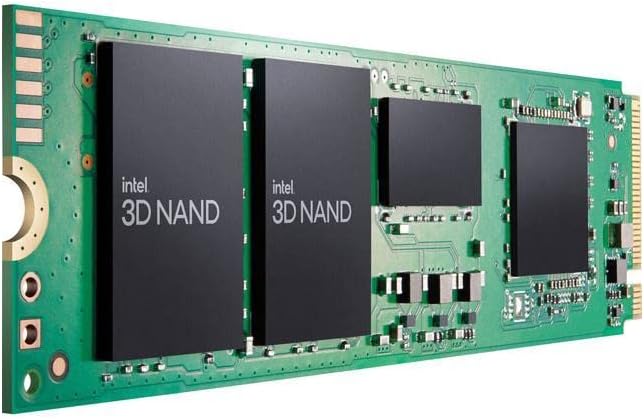
The Intel 670p Series M.2 2280 512GB represents a refined iteration of Intel’s consumer solid-state drive lineup, targeting users who require faster application loading and snappier boot sequences. Utilizing the PCIe NVMe 3.0 x4 interface, this drive pushes sequential read performance up to 3000 MB/s—nearly double the read speed of the previous generation—alongside sequential write speeds of up to 1600 MB/s. By packing updated QLC NAND onto an M.2 2280 form factor, it offers a focused balance of read throughput and everyday responsiveness.
This 512GB module is particularly well suited as a dedicated boot partition for workstations or a primary drive for compact office laptops. Professionals looking for a dedicated system disk will appreciate how quickly software suites, office utilities, and operating systems initialize under the 3000 MB/s read threshold. In environments where builders frequently weigh mid-capacity boot solutions, such as choosing between this drive and a western digital nvme 500gb module, the 670p stands out by delivering robust PCIe 3.0 read performance that handles multitasking and gaming environments seamlessly.
The primary constraint of this particular configuration is its 512GB capacity ceiling. While 512GB provides sufficient headroom for an operating system, essential business software, and active documents, it leaves minimal buffer for extensive local media libraries, high-resolution rendering caches, or large project archives. Professionals who need extensive local storage without relying on external drives should step up to the 2TB capacity offered by the 660p or transition to high-density Gen5 storage for complex enterprise tasks.
- PCIe NVMe 3.0 x4 interface achieving sequential read speeds up to 3000 MB/s
- Sequential write speeds of up to 1600 MB/s for consistent task execution
- Modern Intel QLC 3D NAND architecture in a standard M.2 2280 format
- Engineered for desktop and laptop computing, gaming, and routine office multitasking
Crucial T705 PCIe Gen5 NVMe 4TB

Crucial
4.3 average from Amazon buyers
- Color
- Black
- Size
- 4TB
- Dimensions
- 3.15 x 0.87 x 0.15 inches
Listed by the seller on the product page.
Best for: High-throughput workstations and heavy creative production pipelines
Pros
- Up to 14,100 MB/s sequential read
- Spacious 4TB Micron TLC NAND
- Hardware encryption and software bundle
Cons
- Requires compatible heatsink cooling
- Demands PCIe 5.0 for top speed
The Crucial T705 PCIe Gen5 NVMe 4TB operates in an entirely different performance tier, engineered specifically for uncompromising creative workstations and high-end desktop rigs. Leveraging the cutting-edge PCIe 5.0 interface, this high-capacity drive achieves blistering sequential read speeds of up to 14,100 MB/s and sequential write speeds of up to 12,600 MB/s. Powered by premium Micron TLC NAND flash and backed by a 5-year warranty, the drive provides four full terabytes of high-endurance storage built to handle the most demanding data pipelines.
For audio-video professionals, 3D visualization artists, and data scientists processing massive datasets, the T705 virtually eliminates storage bottlenecks. It is designed to integrate smoothly with Intel 13th and 14th Generation platforms as well as AMD Ryzen 7000 processors installed in compatible M.2 Gen5 slots. When evaluating high-tier solid-state hardware against top competitors like a samsung m.2 nvme ssd, this drive sets a high benchmark for raw speed. Crucial also includes integrated hardware encryption, Acronis True Image cloning software for seamless system migration, and a one-month Adobe Creative Cloud All-Apps subscription.
Maximizing the potential of this Gen5 drive requires careful attention to system thermals and motherboards. High-speed PCIe 5.0 controllers generate substantial heat during sustained throughput, meaning this heatsink-compatible design must be paired with an effective motherboard heatsink or aftermarket thermal solution to prevent thermal throttling. Furthermore, putting this drive into an older PCIe 3.0 or 4.0 slot will restrict its transfer rates to legacy bus limits, making it an unnecessary investment for basic office productivity hardware.
- PCIe 5.0 NVMe architecture delivering up to 14,100 MB/s read and 12,600 MB/s write speeds
- Generous 4TB capacity utilizing high-endurance Micron TLC NAND flash
- Platform-optimized compatibility for Intel 13th/14th Gen and AMD Ryzen 7000 systems
- Includes hardware encryption, Acronis True Image software, and 1-month Adobe Creative Cloud
What Sets These Models Apart
| Model | Interface and Form Factor | Capacity and NAND Type | Sequential Transfer Speeds | Target Workload |
|---|---|---|---|---|
| Intel 660p Series M.2 2280 2TB | PCIe NVMe 3.0 x4, M.2 2280 | 2TB, Intel QLC 3D NAND | 1800 MB/s Read / 1800 MB/s Write | Secondary storage, bulk archives, general office multitasking |
| Intel 670p Series M.2 2280 512GB | PCIe NVMe 3.0 x4, M.2 2280 | 512GB, Intel QLC 3D NAND | 3000 MB/s Read / 1600 MB/s Write | Operating system boot drive, routine desktop workflows |
| Crucial T705 PCIe Gen5 NVMe 4TB | PCIe Gen5 NVMe, M.2 2280 | 4TB, Micron TLC NAND | 14,100 MB/s Read / 12,600 MB/s Write | Heavy video editing, 3D rendering, high-end creative computing |
Buying Tips for Intel NVMe SSDs
When selecting a solid-state drive for your computer, the first technical factor to examine is the relationship between the drive interface and your motherboard slot. A pcie nvme 3.0 x4 intel ssd operates on third-generation PCI Express lanes, delivering maximum theoretical throughput around 3500 MB/s. While modern PCIe 5.0 drives offer extraordinary transfer rates, they are fully backwards compatible with PCIe 4.0 and PCIe 3.0 slots, albeit limited to the ceiling of that specific slot. If your motherboard lacks native Gen5 support, purchasing an ultra-high-speed module will not yield higher speeds until you upgrade your underlying CPU and chipset architecture.
Understanding NAND flash cell architecture is equally vital when planning your storage configuration. Intel QLC NAND stores four bits of data per memory cell, enabling higher capacities on compact circuit boards at an accessible manufacturing cost. This design excels in read-heavy environments like running operating systems, launching business software, or accessing file archives. In contrast, triple-level cell (TLC) NAND stores three bits per cell and delivers superior endurance and write stability during sustained data transfers. For entry-level workstations or budget-friendly computing platforms such as an hp 14 inch hd windows laptop amd athlon 7120 4gb ram 128gb ssd moonlight blue, energy-efficient QLC drives provide more than enough throughput without excessive thermal output.
Thermal management and physical clearance also play a major role in choosing the best intel ssd for pc builds. Standard M.2 2280 drives measure 22mm wide by 80mm long, fitting seamlessly into most modern laptop slots and desktop motherboards. However, the high-performance controllers found on next-generation Gen5 drives draw considerably more power and require substantial passive or active heatsinks to prevent performance throttling. Before purchasing, verify whether your laptop chassis provides adequate clearance for dual-sided boards or integrated heat spreaders, and ensure your desktop motherboard includes sturdy M.2 thermal shielding.
FAQ
Which intel nvme ssd to buy for routine office tasks and web browsing?
For everyday business productivity, document management, and web navigation, the Intel 670p Series M.2 2280 512GB is an ideal choice. Its sequential read speed of up to 3000 MB/s ensures that your operating system boots instantly and applications launch without delay, providing all the throughput necessary for standard corporate workloads without requiring extra thermal hardware.
Can an intel m.2 nvme drive be installed in any laptop with an M.2 slot?
An intel m.2 nvme drive requires an M.2 slot that is wired directly to PCIe lanes and supports the 2280 physical form factor (22mm wide by 80mm long). While most modern laptops feature M.2 slots, some older or ultra-budget models only support M.2 SATA drives or feature shorter physical slots such as 2230 or 2242. Always inspect your laptop documentation to confirm M.2 NVMe PCIe compatibility before purchasing an upgrade drive.
How does Intel QLC NAND compare to Micron TLC NAND in professional workloads?
Intel QLC (Quad-Level Cell) NAND stores four bits per cell, which maximizes storage density and makes high-capacity drives very practical for read-heavy tasks and general productivity. Micron TLC (Triple-Level Cell) NAND stores three bits per cell, providing higher sustained write endurance, faster continuous data writing, and better resilience under heavy creative workloads such as 4K and 8K video scrubbing or 3D asset generation.
Does a PCIe Gen5 SSD like the Crucial T705 work in an older PCIe 3.0 system?
Yes, PCIe technology is backwards compatible. A PCIe Gen5 NVMe drive will function properly in a PCIe 3.0 or PCIe 4.0 M.2 slot. However, its sequential read and write speeds will be capped by the physical bandwidth limit of that older bus generation—roughly 3500 MB/s on a PCIe 3.0 x4 interface—preventing you from reaching its full 14,100 MB/s theoretical capability until you migrate to a Gen5-ready motherboard.
Do these NVMe SSD drives require a dedicated heatsink during operation?
PCIe 3.0 drives like the Intel 660p and Intel 670p generate modest heat and can safely operate without dedicated heatsinks in standard desktop cases and well-ventilated laptops. In contrast, extreme-speed PCIe 5.0 drives like the Crucial T705 require an effective motherboard heatsink or specialized thermal cooler to dissipate heat rapidly and maintain peak operational performance without thermal throttling.